I've cooked a lot of chicken. And I've gotten sick from it exactly once — not because I skipped the thermometer, but because I trusted a number that was right on the edge. Chicken food safety temperature isn't about hitting 165°F and calling it a day. It's about where that number comes from, how your thermometer lies to you, and what happens in the two minutes after you pull the meat off the heat. Below is what actually matters if you want safe chicken without turning it into shoe leather.
Quick Jump — What You Need
Why 165°F Is the Number (And What It Doesn't Guarantee)
165°F is what the USDA calls the instant-kill temperature for Salmonella in poultry. The word instant is doing heavy lifting there. At 165°F, bacteria die within seconds. But the same bacteria die at 150°F if you hold that temperature for roughly three minutes, or at 145°F for about nine minutes. This is called time-temperature equivalence, and it's why sous vide chicken at 145°F is safe while a roasted breast pulled at 145°F and served immediately is riskier.
Here's the non-consensus part: most recipes tell you to aim for 165°F as the final temp. That's a recipe for dry chicken. I aim for 158-160°F in the breast and let carryover take it to 165. The meat is safe and noticeably juicier. The absolute floor for whole-muscle chicken held briefly is 155°F, but I don't recommend it for ground chicken — that needs the full 165°F with no resting window.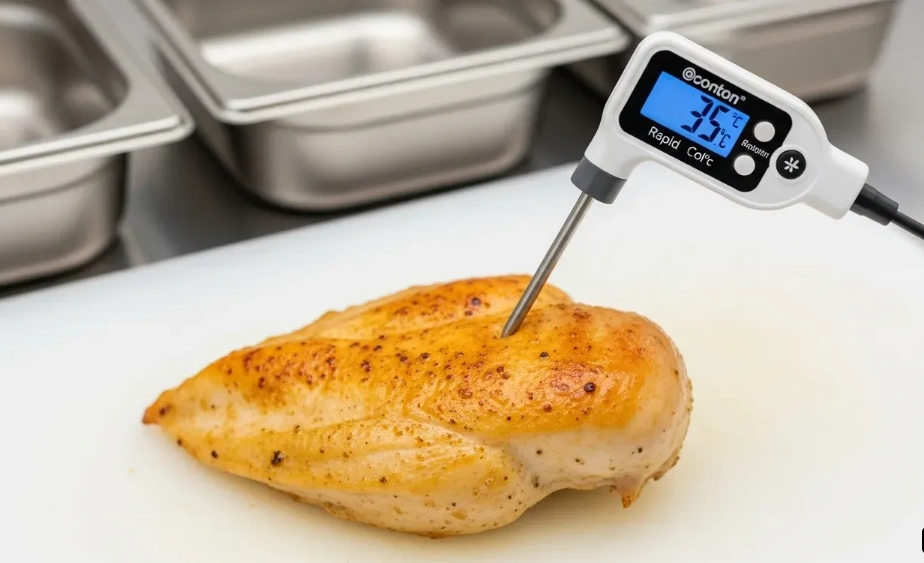
The 40-140°F Danger Zone in Real Kitchen Terms
Bacteria multiply fastest between 40°F and 140°F. The official guidance says two hours max in this range, one hour if the room is above 90°F. In a summer kitchen with the oven running, that one-hour window closes faster than you think.
| Scenario | Safe Window | What to Do |
|---|---|---|
| Raw chicken on counter before cooking | Under 30 min | Keep it in the fridge until the pan is hot |
| Cooked chicken cooling on counter | 2 hours max | Refrigerate in shallow containers at the 1-hour mark |
| Marinating at room temp | Don't | Marinate in the fridge, always |
| Leftovers in a hot car | 1 hour | Bring a cooler or skip it |
The cooked-chicken cooling rule catches people. I see friends leave a whole roast chicken out for three hours while they eat dinner. That's a gamble. I break it down into pieces within 45 minutes and chill it — the smaller surface area drops the internal temp through the danger zone much quicker.
How to Read a Thermometer Without Fooling Yourself
A $9 dial thermometer from the grocery store can be off by 10 degrees. That's the difference between safe and not. I use a digital instant-read probe, and I calibrate it every few weeks with the ice water method: fill a glass with crushed ice and water, stir, insert the probe at least two inches, and it should read 32°F. If it's off by more than two degrees, adjust or replace it.
Where you probe matters more than people realize. The thickest part of the breast, away from bone and fat. Bone conducts heat differently and reads higher than the meat around it. On a whole bird, I check the thigh (dark meat needs 175°F for texture, even though 165°F is safe) and the breast separately. If they're more than 15 degrees apart, my oven is running uneven — a common issue with older ovens that pushes people to overbake the breast while the thigh finishes.
What about the pop-up timer?
Those little plastic buttons that come in supermarket chickens are set to fire at 180-185°F. They're not a safety tool; they're a liability. By the time it pops, the breast is dust.
Carryover Cooking: The Two-Minute Window That Saves You
This is the part I wish someone had told me earlier. When you pull chicken off heat, the outside is hotter than the inside, and heat keeps moving inward. A breast pulled at 160°F will coast up to 165-168°F in five minutes on the counter, loosely tented with foil. That's why I pull at 160 and rest ten minutes.
The flip side is just as important: don't rest chicken in a cold pan or a drafty spot. I've watched a roast drop from 160°F back to 145°F in ten minutes on a stone counter in winter. That's a reverse carryover, and it's exactly the kind of thing that isn't in the textbook. Use a warm plate or a turned-off oven with the door cracked.
Mistakes I Still See in Home Kitchens
Probing the bone. I did this for years. The bone heats faster and reads 10-15 degrees hotter than the surrounding meat. You think the chicken is done when the center is still cold. Probe the meat, not the frame.
Trusting color. Pink near the bone is often myoglobin, not blood, and it's fine in young chickens. But pink in the thickest part of the thigh is a red flag. Color alone is unreliable in both directions — I've had gray, dry chicken that was under 160°F in the center.
Cooking from frozen in a slow cooker. Frozen chicken breasts in a crockpot spend hours in the danger zone as they thaw. I know the recipe blogs say it's fine. It isn't. Thaw in the fridge overnight, or use the defrost setting and cook immediately.
Reheating to "warm." Leftover chicken needs to hit 165°F again, not just feel hot. A microwave on 50% power for two minutes gets there unevenly — I stir or flip at the one-minute mark. The center of a thick piece is the last to heat, and it's the one that matters.
Questions I Get Asked Most
My chicken hit 165°F but the juices are still pinkish — is it safe?
Pink juice is almost always myoglobin, especially in younger birds or meat near the bone. If the thermometer read 165°F in the thickest part away from bone, it's safe. What worries me more is cloudy or thick juice combined with meat that shreds too easily — that's a sign of spoilage before cooking, not undercooking.
Can I eat chicken that sat out for three hours if I reheat it to 165°F?
No. Reheating kills bacteria but not the toxins they've already produced. Those toxins survive boiling. Three hours in the danger zone is a hard no for me, and it should be for you too. The two-hour rule is not a suggestion.
Is 145°F chicken breast safe if I hold it there for ten minutes?
Technically yes, per time-temperature tables. Practically, holding a home oven at exactly 145°F for ten minutes is hard to do accurately, and the texture is odd — slightly translucent. I'd only trust this with a sous vide setup where the temperature is precise. For oven roasting, 160°F with carryover is my sweet spot.
How long can cooked chicken stay in the fridge?
Three to four days at 40°F or below. I label the container with the day I cooked it because I will absolutely forget. Day five is where I start sniffing and second-guessing, and at that point it goes in the trash. Smell isn't a reliable safety test, but it's a good prompt to check the calendar.
Fact-checked against USDA FSIS safe minimum cooking temperature guidance and FDA refrigeration storage charts. All temperature recommendations reflect current published food safety standards.
Leave a Comment